






《Dr.もん次朗81》Beyond Fast-Twitch Dominance: The Power of Deep Stability
2026/09/14
Beyond Fast-Twitch Dominance: How Deep Stability Unlocks Effortless Power
Beyond Fast-Twitch Dominance: What Traditional Japanese Movement Can Teach Today’s Athletes
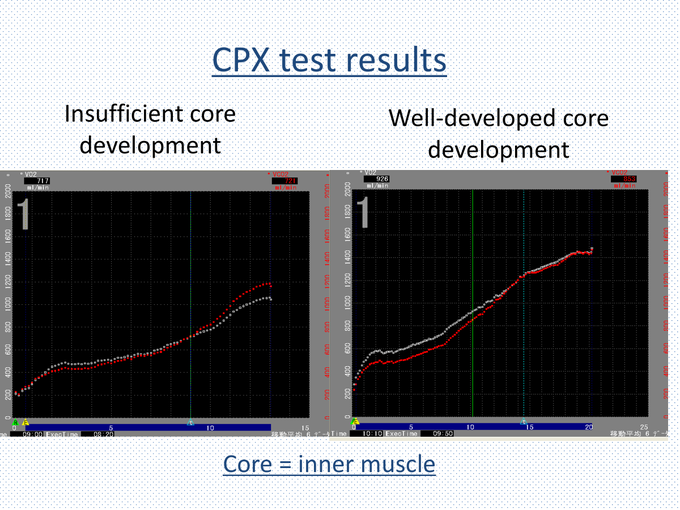
For more than thirty years—since the year before the J.League was launched—I have worked as a physical advisor, conducting cardiopulmonary exercise testing (CPX) for several football teams, including S-Pulse and the Japan national team under head coach #TakeshiOkada, widely known as “Okada Japan.”
Throughout those years, one conviction has continued to grow stronger:
To all athletes and coaches:
It is time to move beyond the belief that fast-twitch muscle is everything.
Much of modern sports training emphasizes high-intensity exercise, weight machines, and the visible power produced by fast-twitch and superficial muscles—the outer-muscle system.
As a result, athletes and coaches can easily fall into a simplistic equation:
More force = more power from the outer muscles.
But this overlooks something fundamental: the endurance and structural stability created by the deeper muscle system, together with the coordinated functions of the Deep Front Line (DFL) and Anticipatory Postural Adjustments (APA).
Compared with highly visible fast-twitch training, inner-muscle training—the quiet foundation beneath athletic performance—receives far too little attention.
True relaxation, or datsuryoku (脱力), does not mean becoming loose or inactive. It means remaining free of unnecessary tension while maintaining stability from within—and activating the powerful outer muscles only when they are truly needed.
To develop this ability, athletes must refine the subtle sensory information arising from within the body: proprioception involving the muscle spindles and tendon organs, as well as the vestibular system.
They must also learn to listen inwardly and develop an ongoing dialogue with their own bodies.
Masters of traditional Japanese martial arts, including Miyamoto Musashi, described principles such as “letting go of the self” and “taking away the opponent’s rhythm.”
The relaxed yet explosive first movement—and the remarkable endurance—seen in a small number of world-class athletes may represent the highest expression of deep structural stability, whole-body coordination, and anticipatory postural control.
Their movements appear effortless, but enormous power emerges at exactly the right moment.
For me, MLB pitcher Yoshinobu Yamamoto is an outstanding modern example.
The goal is not simply to build larger or stronger muscles.
Build the inner pillar.
Remove unnecessary tension.
Connect the whole body.
Then let power emerge.
#FastTwitch #InnerMuscle #OuterMuscle #DFL #APA #Proprioception #Datsuryoku #AthleticPerformance #SportsTraining #MLB山本由伸 #YoshinobuYamamoto
DFL: The Deep Front Line—a deep myofascial pathway contributing to postural support and whole-body integration.
APA: Anticipatory Postural Adjustments—the nervous system’s automatic preparation of posture and trunk stability before voluntary movement begins.

≪to be continued≫
Dr.Momjiro#81(9.14)


